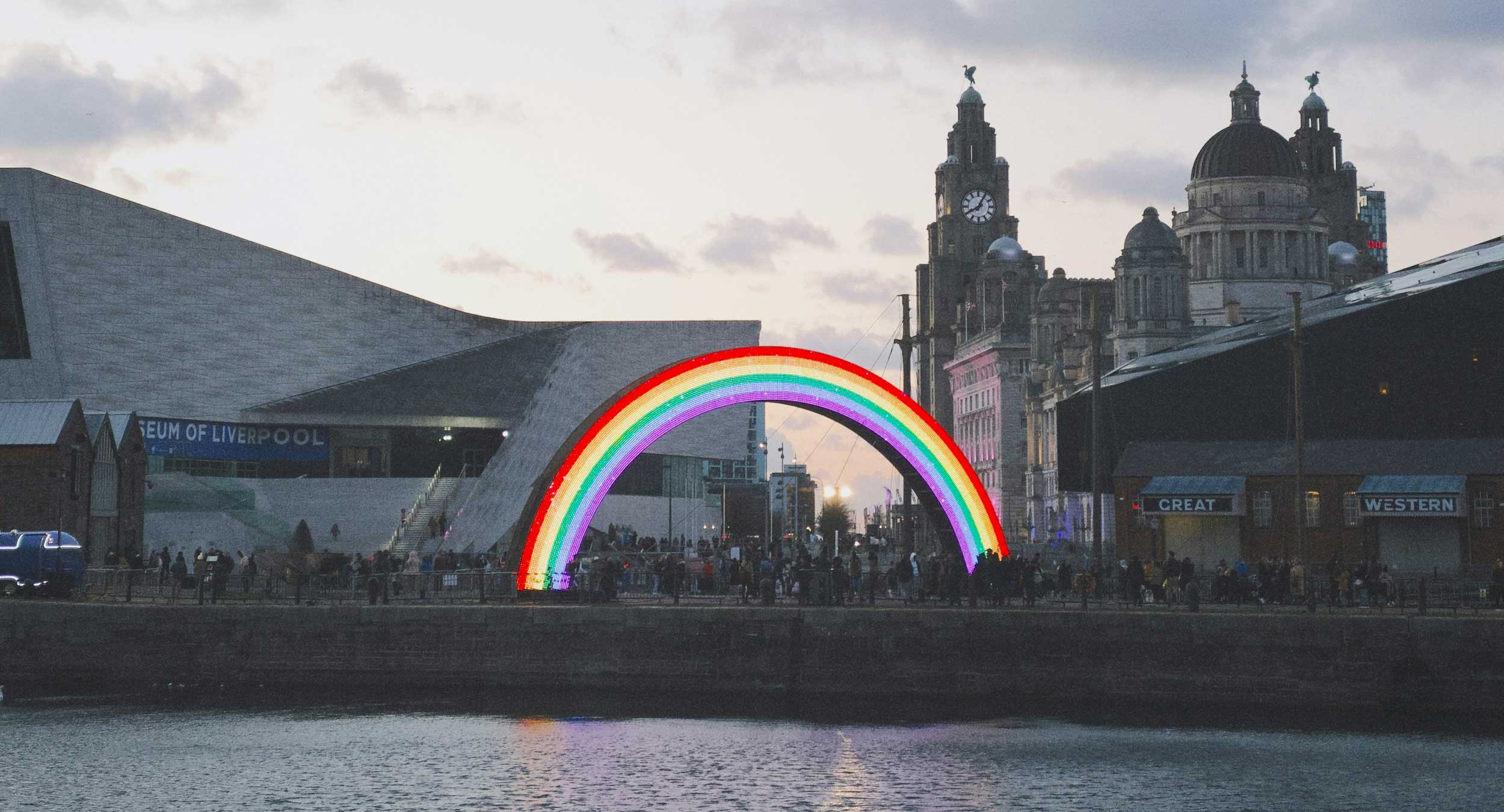
To meet the UN’s Sustainable Development Goals by 2030, new models, mindsets and ways of working are needed – environmentally, socially and economically. Creating healthy places to live is a fundamental part of achieving those goals.
Beatrice Fraenkel is an industrial designer and ergonomist specialising in designing systems that make a meaningful and measurable difference to people’s lives. Passionate about sustainable urban design, Beatrice has been Chair of several regeneration bodies and led a major regeneration project for Liverpool. She was also a member of the UK government’s High Street Task Force, non-executive director of Stockport NHS Foundation Trust, and former chair of Mersey Care NHS Foundation Trust.
In this latest instalment of Calvium’s Sustainable Urban Futures interview series, Beatrice reflects on what makes cities genuinely healthy, why governance should be built around shared outcomes rather than organisational boundaries, and how trust, collaboration and thoughtful leadership create the conditions for lasting change.

How did industrial design become the foundation for your work across regeneration, healthcare and public leadership?
I qualified quite a long time ago as an industrial design engineer and then did a post-graduate course in ergonomics. That gave me a really interesting base, which sits between both my heart and my head of looking at problem-solving design solutions. Particularly in the physical sense, which is focused on the needs of the recipient not the client.
The rest of my career has involved a combination of private and public sector work, including as a councillor in Liverpool for 30 years, where I delivered a big regeneration programme during a very difficult political period. But I also had the wonderful experiences of chairing a primary care trust when they were the first wave of change in the NHS, and chairing Mersey Care NHS Foundation Trust, which is a mental health and community trust for Merseyside and beyond.
All of this requires a ‘whole’ way of looking at the world, which is where I act as the interpretive bridge between different stakeholders and ensure everyone is speaking the same language and enables effective learning and collaboration.
From your broad experience across design, governance and healthcare leadership, how would you describe a “healthy” city?
The term healthy cities means different things to different people, but for me it is somewhere which makes anybody feel they want to go and be in that place. It combines the physical and the emotional health of any one of us. When choosing where we do or don’t want to visit, we’ll often find it’s because it’s a combination of factors, including: does it give us the choice of what we want when we get there? Does it make us feel that the journey to get there is easy or strong enough in our motivation to take us there? When we get there, are the feelings that we get from it sufficient to make us want to spend time there and return?
One example that shaped my thinking, came during my time as design champion for Liverpool, I worked alongside Grosvenor’s Rod Holmes during the redevelopment of Liverpool city centre. We spent time discussing the economics of an area. The more footfall you generate and the longer you can keep somebody in a space, the more important that is to the economics of place. That has a direct economic impact in terms of rental value, investment and sustainability and employment, all critical aspects of creating a healthy city.
We spent time talking about what makes somebody feel safe physically and emotionally. Detail matters, so the way in which every flagstone was laid was important because we all get an unconscious sense of security if we’re walking on a safe, flat, well-maintained surface. The detail in that is a real lesson in understanding how our psychology and physical reactions are aligned.
Hospitals are an example of buildings being designed in a very particular way to meet a range of needs, physical and mental, but it applies in the same way to cities to make them healthy. Texture, smell, sounds, curiosity about what’s round the corner and wanting to find out ; everything that creates a pleasing environment is very important. I would add the word ‘beauty’ matters as well, and understanding using good design underpins achieving high quality outcomes.

Clock View Hospital in Walton, Liverpool, designed by Medical Architecture. Read an interview with Beatrice about the design in Architects Journal.
How can cities move from treating illness to creating the conditions for better health?
A few significant changes are happening currently which can make positive changes to health outcomes – both in terms of repairing and prevention. There are changes to political structure, with the introduction of mayoral authorities, and significant changes in how the role of health services are being redesigned to help keep us out of hospitals.
When we’re talking about how to bring those major organisational assets – not just finance, but knowledge and understanding – then you have an opportunity to check what can be done to improve outcomes in a new way. From there, we can start to understand where there isn’t equity. We are getting much better at using and sharing data about what’s happening in real-time so we can apply a very different model of sharing risk outside of mayoral authorities and organisations like the NHS.
This allows you to build a cycle of self-support in local communities, which benefits everyone – the individual, their family and the community socioeconomically. Importantly, it is this kind of independence that gives a greater feeling of self-worth too.
To make that work, organisations also need to be willing to share responsibility rather than simply share information. We’re becoming much better at using data to understand what’s happening in real time and where inequalities persist, but the opportunity is to use that knowledge differently. By sharing risk, skills and resources across organisations – including local authorities, health services and voluntary groups – we can move from reacting to problems towards preventing them.
The aim isn’t equality, where everyone receives the same response, but equity, understanding where needs differ and aligning support accordingly. When communities themselves become part of that process, rather than simply recipients of services, you begin to build local capacity and independence. That benefits individuals, families and neighbourhoods alike, while helping public services use their resources more effectively.
What does good governance look like in urban design and who should be held accountable for wellbeing decisions?
Good governance starts by each understanding what the shared outcome of what you’re trying to deliver is and then stepping back and agreeing which part of the system can be a partner in getting to that point.
You’re setting up what is almost like a joint contract of shared outcome, which you are then monitoring and taking account of in your own organisational oversight. Understanding how that relates to your own regulator and audit trail allows you to share risk and understand the impact on other people’s parts of the programme.
Most of us are accountable in different ways to different systems – that word must mean both accountability to the community and accountability to the regulator because you must work with both. Hiring the right skills is essential, but you must ensure everyone understands why what you’re doing matters. Ultimately, good governance isn’t about protecting organisational boundaries, it’s about ensuring that every organisation understands the shared outcome it is helping to achieve and has the right oversight and accountability in place.
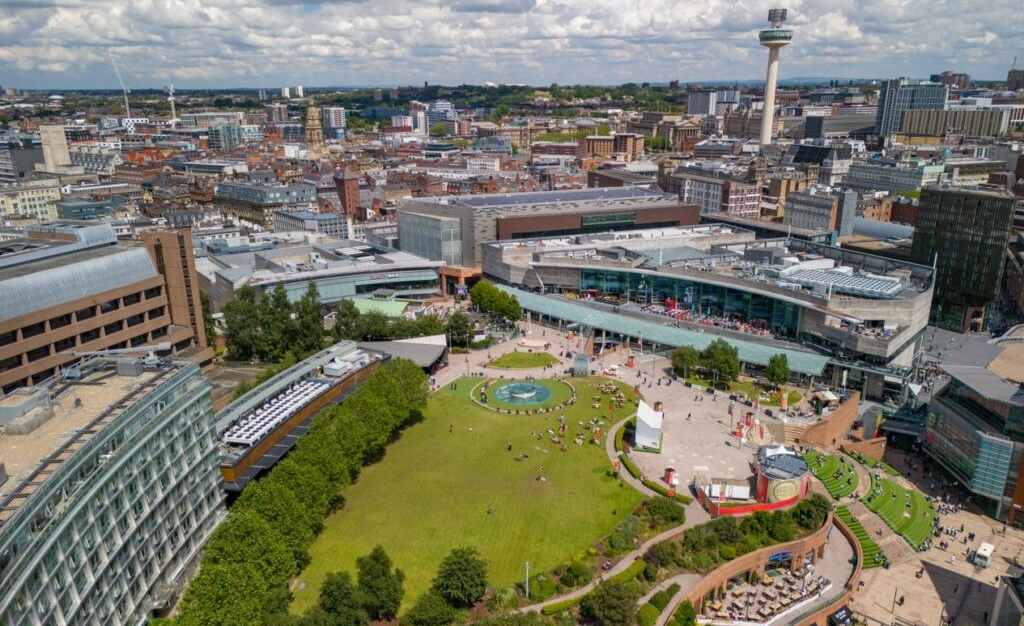
Liverpool ONE is a retail and entertainment destination, with ESG accreditations including Green Flag, Green Heritage Site and ISO14001 for the sustainable environmental management systems across the development. Photo: Liverpool ONE
How has your experience helped to bridge the gap between policy, design and lived experience in urban environments?
Often, there is a big misunderstanding of what different organisations mean by regeneration, so you must understand that you don’t necessarily share the same understanding at the outset, and check and test how to build a shared foundation for delivery.
The combination of my experiences has allowed me to act as an important bridge between a huge range of organisations who normally are quite isolated. Many organisations can feel very threatened by this word ‘collaboration’, but it is just about understanding each other and working out how we can deliver something together.
Crucially, it’s not about blame. It’s about learning and feeling safe to make mistakes.
Ultimately, the focus must be on understanding what the needs of the recipient are, and how to monitor if you’re getting there or not.
The case for inclusive design and accessibility keeps having to be made. What must be put in place, once and for all, for our spaces to be inclusive and accessible?
We talk a lot about sustainability but not as much about the sustainability of our own health and wellbeing. While there is planning legislation, which is an obvious place to build it in, it’s about the willingness to invest. Everybody thinks that’s something they would like to do and knows that they should do, but don’t necessarily have the demand made in the right way to do it against the other pressures which are given priority.
Wherever money is being spent – whether it’s a highway, shop or hospital – we should be aiming for more than the minimum standards of accessibility and have a look at what is needed. If it works for people who have some form of disability, it’s going to work for every one of us. It’s about creating choice and flexibility, and spending the time needed to get it right.
A good example comes from Liverpool’s regeneration in the early 1990s. We were given £1m to develop the infrastructure of a derelict area. We had the chance to look at the unique complexity of buildings and communities – some of the most disadvantaged communities in Liverpool – to create something that both engaged the community in reshaping their part of the city, bringing it back to life and attracting investment. Without engagement and involvement of the local and very suspicious community, we couldn’t have got it off the ground.
One of the things that occurs to me often is how much time you need to give to the project planning before even starting the delivery. When we were regenerating Liverpool Rope Walks we spent three of the five years in the planning and consultation phase and two years delivery, but the social and economic results showed the evidenced benefits of this approach even before final scheme completion.
To get it right, you must include people who are rooted in the place locally – engaging, listening and learning from them. Once you do this, you can start to create something that is healthy and enhances the lives of all communities, without conflicts.
If we invest the time to understand people’s needs before we build, we’re not simply creating more accessible places, we’re creating places that remain healthier and more resilient for future generations.
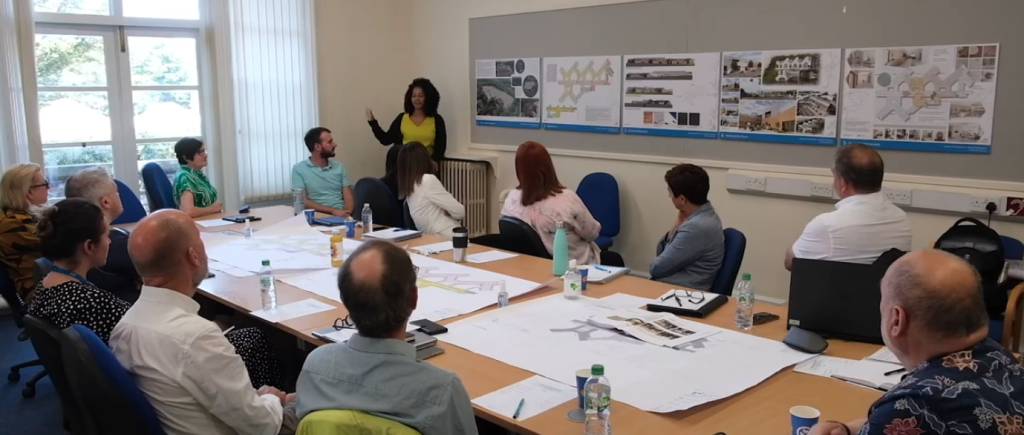
Design Champions meeting at former Mossley Hill site, a group set up through the NHS Design Board.
How might we reframe uncertainty in urban development as a driver of innovation rather than something to be feared or minimised?
We should never assume that we have all the information or knowledge needed to arrive at the best or most imaginative solution to a problem and innovation can cause discomfort.
You must be able to build trust; without that, you’ve not got much chance. One of the skills in leadership is gauging pace and making sure that by moving at a pace that delivers but keeps everyone together.
Ultimately, that balance depends on trust. Innovation only happens when people feel confident enough to work differently, knowing that mistakes will be treated as opportunities to learn rather than reasons to assign blame. Building that trust takes time. It requires openness, transparency and a shared understanding that everyone is working towards the same outcome. That’s why leadership is not simply about setting direction; it’s about creating an environment where people feel safe enough to contribute, adapt and learn together. Without that psychological safety, organisations naturally become more cautious, and innovation slows. If we want to innovate at the pace today’s challenges demand, we have to build trust first and create cultures where learning is valued as highly as delivery.
“You have to build trust first if you want innovation at the speed that’s needed.”
It’s such a difficult conversation because we all like to think we are trustworthy. But there are points at which it’s not about trust, but courage – even during times of uncertainty. Which is why I go back to not blaming but learning. Unless you can take yourself through that barrier and feel safe to do so, you’re not getting the innovation at the speed that’s needed.
Digital technologies and AI are helping us analyse information, coordinate organisations and understand communities in ways that simply weren’t possible before. Used well, technologies can strengthen decision-making rather than replace it. What impact are digital technologies having on urban design?
I can see that digital and AI are shifting people’s capacity to do things and have the potential to be far more effective than relying on someone trying to pull everything together from a computer, or cupboard, in an office. They give us the opportunity to understand what’s happening across complex systems, to share information more effectively and to see patterns that help us to make better decisions.
What matters, though, is not the technology itself, but how we use it. Throughout my career I’ve found that the biggest challenge is often helping organisations understand one another well enough to work towards a shared outcome. Digital tools can support that by making knowledge, evidence and data much easier to share across organisational boundaries. Used well, they help us coordinate rather than work in isolation, and they allow us to focus more clearly on whether we’re improving outcomes for the people we’re designing for.
At the same time, technology should never replace judgement or debate. We still need to understand local context, listen to communities and ask whether we’re solving the right problem in the first place. Digital tools can inform those conversations, but they can’t substitute for them.
It’s also important to talk to people younger generationally than ourselves. They often can’t understand that, generationally, we don’t always understand the present, never mind the future. Sometimes we need to bring 20-year-olds into the conversation because they’ll naturally challenge assumptions that the rest of us don’t even realise we’re making. That willingness to learn across generations is just as important as the technology itself.
Ultimately, I see digital and AI as enabling better collaboration, better evidence and better decisions. But like any tool, their value depends on whether they help us to create places that genuinely improve people’s lives.
Thank you Beatrice for sharing your experience, insight and expertise, and discussing how creating healthier, more sustainable places depends not only on good design, but on trust, collaboration and the willingness to invest time in understanding people before designing solutions.
Contact us at hello@calvium.com and +44 (0) 117 226 2000 to deliver sustainable, care-filled and impactful digital innovation.
Subscribe to the monthly Calvium newsletter to get more insight and inspiration like this in your inbox.
More from our Expert Interview series
Hear from other expert practitioners, bringing their lived experience into delivering positive innovation:
- Andrew Lansley, global sustainability and accessibility innovation specialist
- Andrew Morris, Executive Director, British Society of Soil Science
- Ben Hawes, Technology Consultant, Researcher and Associate Director, Connected Places Catapult
- Ceren Clulow, Programme Director, Connecting Cambridgeshire
- Christine Hemphill, Founder, Open Inclusion
- Daisy Narayanan MBE, Public Realm Director, The Crown Estate
- Dan Cook, Assessor, Cambridge Institute for Sustainability Leadership
- Prof Daniel Armanios, BT Professor of Major Programme Management, Saïd Business School, University of Oxford
- Jackie Copley, Campaigns Lead, CPRE
- Joel Mills, Senior Director, Architects Foundation Communities by Design
- John Worsfold, Head of Solutions Innovation, RNIB
- Ludo Pittie, Head of Landscape, WSP
- Marc Cairns, Managing Director, New Practice
- Mark Hallett, Regeneration Associate, The Good Economy
- Paul Wilson, senior advisor and consultant on smart cities
- Dr Phil Askew, Director of Landscape, Peabody
- Prof Peter Madden, Professor of Practice in Future Cities, Cardiff University
- Steve Sayers, Chief Executive, Windmill Hill City Farm
- Warren Smith, Director of Insight, Innovation and Impact, Posterity Global
- Will Weston, Accessibility and Inclusivity Consultant, All Ways Access