
Meeting the twin challenges of achieving net zero emissions by mid-century and delivering the UN Sustainable Development Goals by 2030 will require more than technological progress alone. It will demand new forms of collaboration, governance and innovation, alongside a renewed focus on the public good. The decisions we make today will shape how emerging technologies influence the places we live, the services we rely on and the futures we create.
To explore these questions, I’ve been speaking with leading voices working across sustainability, technology, policy and innovation about the opportunities and challenges involved in building sustainable urban futures.
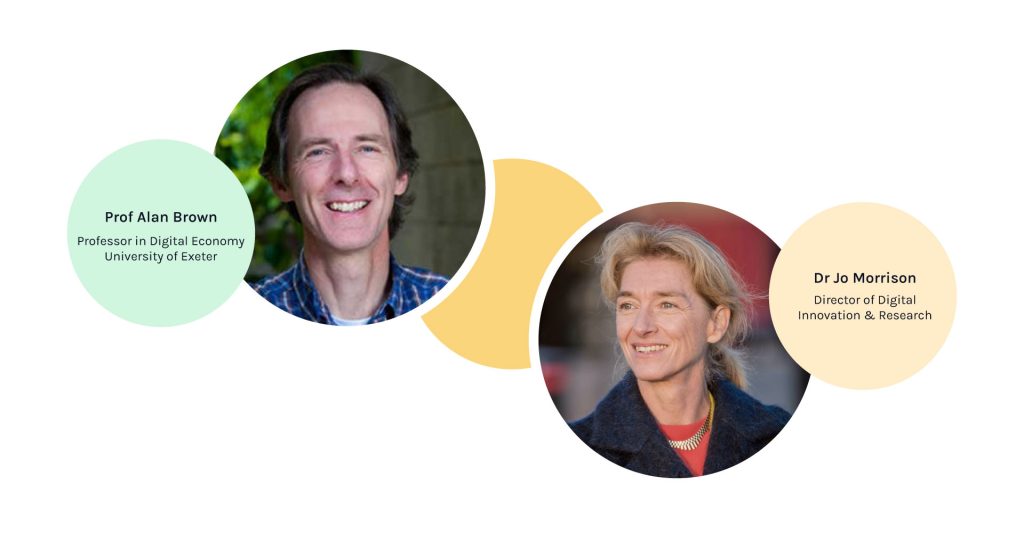
To explore Artificial Intelligence, the natural person to contact was Professor Alan Brown, who, more than a decade ago, was asking many of the same questions now being raised about AI.
In Digitizing Government, written with Mark Thompson and Jerry Fishenden, Alan challenged the prevailing assumption that digital technologies would transform public services simply by replacing inefficient processes and automating human work. Instead, he argued that successful digital transformation depended on institutions, governance, organisational culture and a clear understanding of public value. Today, as governments and organisations race to adopt AI, he sees striking parallels.
As Professor in Digital Economy at the University of Exeter and author of the recently published Making AI Work for Britain: From Strategies to Practice, Alan has spent much time examining how emerging technologies reshape organisations, public services and civic life. His latest book argues that the success or failure of AI will depend less on the sophistication of the technology itself than on the quality of the institutions surrounding it.
The challenge is not simply to build more powerful systems. It is to ensure that those systems strengthen public services, expand human agency and support democratic accountability rather than concentrating power or reinforcing existing inequalities.
So what would it mean for AI to genuinely work for Britain?
More than ten years ago you wrote ‘Digitizing Government’. How did that experience shape your thinking about AI?
When we wrote Digitizing Government, we were responding to a particular narrative that had emerged around technology and public services. The assumption was that digital technologies would make government more efficient by replacing people, automating processes and removing cost from the system. There was a strong belief that technology itself was the solution.
We felt that was fundamentally the wrong way to think about the challenge. Our argument was that government should be viewed as a platform that exists to support people, communities and society. Technology is an enabler of that mission, not a substitute for it.
We were also concerned by the assumption that old ways of working could simply be discarded and replaced with new technology. Some change was necessary, of course, but there was often a lack of appreciation for the institutional, organisational and human dimensions of transformation.
When I look at the current AI debate, many of those same themes have reappeared. AI is undoubtedly different, and it raises new questions and extends what technology can do in ways that weren’t possible a decade ago, but once again, we’re seeing a tendency to focus on technological capability while paying less attention to governance, institutions and societal outcomes.
What lessons from that period are most relevant today?
The biggest lesson is that technological progress does not automatically translate into societal progress. Over the past decade we’ve sometimes used digital technologies to narrow services, standardise experiences and prioritise efficiency over people’s actual needs. AI today creates a risk that we repeat those mistakes at greater scale.
If the primary objective becomes automation, cost reduction or replacing human activity, then we’re likely to miss much larger opportunities to improve services and create public value. The real challenge is still understanding the relationship between technology, people and society.

Photo: Paul Rigel
Public debate is often dominated by large foundation models and the handful of companies leading their development. Are we in danger of mistaking one particular vision of AI for the whole potential future of the technology?
I think we are. Over the last five or six years a particular approach to AI has become dominant. Large neural networks trained on enormous datasets have produced extraordinary results and understandably captured public attention.
After decades of intermittent progress and several so-called AI winters, systems such as ChatGPT changed people’s expectations almost overnight. But that success came through a very specific model of development. It relied on enormous investment, vast computing resources and the ability to train systems at a scale that only a small number of organisations could afford. That naturally concentrated power in the hands of a few companies. The risk is that we begin to assume this AI architecture is inevitable.
So what alternatives do you see emerging?
Increasingly, researchers and organisations are asking a different question: how far can we get with smaller models? What happens if infrastructure is opened up? What happens if common platforms can be customised for different users, needs and contexts? What happens if we move away from the assumption that every problem requires a giant general-purpose model? We’re already seeing growing interest in open models, smaller models and approaches that are more closely tuned to the problems people are actually trying to solve.
Part of the current narrative is driven by economics. A small number of organisations have invested enormous sums in frontier-model development and naturally want to recoup those investments. That creates a powerful incentive to argue that this is the path everyone must follow. I’m not convinced that’s the only future. I think we’re likely to see a much broader range of approaches emerge over the next few years.
Where does Britain fit into that landscape?
Britain is in a somewhat awkward position. The United States and China increasingly see AI as a strategic capability tied to economic power, national security and geopolitical influence. Europe has pursued a more regulatory approach. The UK sits somewhere between those models, we’re a little bit trapped in the middle, not fully aligned with any of them, but not entirely outside them either.
Britain’s strengths are its universities, research base and long-standing expertise in areas such as mathematics, statistics, computer science, law and regulation. Those strengths position the UK as a trusted academic and regulatory partner.
The more difficult challenge lies on the industrial side. While political leaders often talk about Britain becoming an AI superpower, competing directly with the largest technology firms on software platforms, infrastructure and hardware is a much tougher proposition.

Photo: Jonny Gios
Much of the public conversation focuses on future possibilities. Where are you seeing meaningful impact today?
More broadly, we’re beginning to see organisations use AI to bring together information that was previously fragmented or disconnected. In local government and public services, that can create a much richer understanding of communities, service demand and emerging needs. Information that once sat across multiple systems and organisations can be connected in ways that help authorities understand where services are needed, how resources might be allocated more effectively and which groups may be at risk of being overlooked.
The value of AI in these contexts is not simply greater efficiency, it is better understanding. One of the most significant shifts is that we’re moving from asking ‘what is happening?’ to asking ‘why is it happening?’ In healthcare, for example, that means moving beyond treating illness once it appears and towards understanding why people become ill in the first place and whether problems can be prevented earlier.
Realising those opportunities often requires institutions to change as well as technology. Look at higher education as an example. Many universities recognise that learning is becoming more personalised, flexible and continuous throughout people’s lives, yet they remain organised around structures designed for a very different era. Similar tensions can be seen across public services, healthcare and government more broadly. The challenge is not simply adopting new technologies, but adapting institutions, incentives and ways of working to make meaningful use of them.
Can you speak a bit more about this idea of moving from “what” to “why”?
I think one of the most important shifts enabled by AI is moving beyond describing what is happening and beginning to understand why. Historically, many systems have focused on symptoms. Take healthcare. We often intervene once someone becomes ill. We diagnose, treat and manage a condition. Increasingly, we’re asking whether we can understand why illness occurs in the first place. Can we identify patterns earlier? Can we understand the interactions between behaviour, environment, genetics and social circumstances? Can we prevent problems rather than simply responding to them? That’s a much deeper challenge, but it also requires a different way of thinking about institutions, incentives and public services. The real opportunity isn’t simply doing things more efficiently. It’s understanding why problems occur in the first place.

Photo: 1981 Digital
One issue emerging across organisations is so-called ‘shadow AI’, people using tools outside formal governance structures. How concerned should we be?
It’s certainly a challenge, but it’s also understandable. Imagine a social worker preparing to meet a vulnerable family. They have twenty minutes before the meeting and hundreds of pages of case notes to review. An AI tool could summarise that information in minutes. The organisation may not yet have approved that tool. Procurement may still be ongoing. Governance frameworks may still be under development. So what do you do? Do you arrive unprepared? Or do you use an unauthorised tool that may help you provide a better service?
These are the kinds of dilemmas people are increasingly facing as AI tools become available more quickly than organisations can adapt. Procurement takes time. Governance takes time. Training takes time. That said, people are often under pressure to make decisions and deliver services now.
AI is often criticised for reproducing bias and inequality. To what extent are those problems rooted in the technology itself, and to what extent do they reflect the systems and data on which it is built?
Bias is absolutely important, but we sometimes frame it in misleading ways. There’s a tendency to talk about AI as though it has somehow introduced bias into otherwise objective systems. In reality, much of the bias already exists – our data is biased, historical decisions are biased, human decision-making is biased, institutional processes can be biased. Why would we expect systems trained on that history to be free from those influences?
In many ways, AI is reflecting existing weaknesses and inequalities within the systems from which it learns. The danger is that those biases can become amplified, formalised and presented with a false sense of authority, but that should prompt us to examine the underlying systems rather than treating AI as the sole source of the problem.

Photo: Gavin Allanwood
What needs to happen to build public trust?
Transparency and accountability are essential – people need to know where AI is being used, how decisions are being made and who is responsible when things go wrong. Equally important is avoiding dependence on a small number of suppliers.
One principle I’ve argued for is to consolidate demand while diversifying supply. In other words, organisations facing similar challenges should work together, but they should avoid becoming locked into a narrow set of technology providers.
Questions of trust ultimately depend on transparency, accountability and the governance structures surrounding these technologies. People need confidence not only in the tools themselves, but in the institutions responsible for deploying them. Our data is biased. Our human-based decision making is biased.
How can citizens meaningfully influence the future of AI?
That’s one of the most important questions we face. Traditional democratic mechanisms still matter enormously; activities such as public meetings, consultations, civic organisations and elections all remain essential.
But digital technologies also create opportunities to understand communities in new ways. We can gather feedback more continuously, understand how policies affect people in real time and analyse patterns across large groups that were previously difficult to see.
Developments range from online participation and social media engagement to more sophisticated forms of feedback that help policymakers understand the effects of decisions on people’s lives. Used well, these tools could support more responsive forms of governance and create new opportunities for public participation.
Can AI strengthen democracy?
Potentially, yes. It could help broaden participation and create richer forms of engagement, but we shouldn’t imagine that technology removes deeper questions about power, legitimacy and accountability. Who gathers information? Who interprets it? Who acts upon it?
AI may help us understand communities better, but it won’t solve those questions on its own. Issues of power, money, influence and representation remain fundamentally human challenges. Technology may help us make better-informed decisions, but democratic institutions still need to decide how those insights are used and who is accountable for the outcomes. People in power, money and influence… I don’t think we’re going to get rid of those anytime soon.

Photo: Mike Newbry
Looking ahead, what would success look like if AI genuinely worked for Britain?
For me, the answer is ultimately quite simple. By 2030, people should feel that AI supports them, serves them and helps them, rather than feeling that it is something being done to them. If people feel exploited by systems they don’t understand, if a small number of providers are shaping behaviour, narrowing choices or determining how they live and work, then we will have failed.
Success looks very different – it means technologies that help people learn, access services, make decisions and participate in society more effectively, it means public services that are more responsive because they understand people’s needs better. It means communities having a stronger voice in decisions that affect them.
Most importantly, it means preserving human agency. The future shouldn’t be about organising society around AI. It should be about ensuring AI helps people, communities and institutions to flourish. The technologies themselves will continue to evolve, but the more important question is whether our institutions, governance systems and democratic processes evolve alongside them. Ultimately, that is what will determine whether AI works for Britain. I’d like people to feel that AI supports, serves and helps them, rather than AI being something that’s done to them.
Thank you Alan for so generously sharing your time, insight and expertise around delivering on the opportunities and overcoming the challenges of digital innovation for the public sector.
Why this matters for sustainable urban futures
Professor Alan Brown’s argument is ultimately not about artificial intelligence. It is about how societies respond to technological change.
For those working to create sustainable urban futures, the interview offers an important reminder that technology alone does not deliver better outcomes. Whether addressing climate change, health inequalities, housing, mobility, public services or community resilience, success depends on the quality of the institutions, governance systems and democratic processes that shape how technologies are used.
Alan challenges the assumption that innovation automatically leads to progress. Instead, he argues that the real opportunity lies in using technologies such as AI to better understand the complex causes of social and environmental challenges, moving beyond simply asking what is happening to understanding why it is happening.
He also highlights the importance of public trust, accountability and participation. Sustainable places require more than smart technologies. They require citizens to have a voice in how decisions are made, institutions that can adapt to changing circumstances and governance frameworks that ensure innovation serves the public good.
Perhaps most importantly, Alan reminds us that the future is not determined by technology itself. It will be shaped by choices about ownership, control, accountability and purpose. As cities and communities increasingly adopt AI and other digital technologies, the challenge is not simply to deploy them effectively, but to ensure they strengthen human agency, support inclusive decision-making and contribute to more equitable, resilient and sustainable futures.
Contact us at hello@calvium.com and +44 (0) 117 226 2000 to deliver sustainable, care-filled and impactful digital innovation.
Subscribe to the monthly Calvium newsletter to get more insight and inspiration like this in your inbox.
More from our Expert Interview series
Hear from other expert practitioners, bringing their lived experience into delivering positive innovation:
- Andrew Carter, Chief Executive, Centre for Cities
- Andrew Lansley, global sustainability and accessibility innovation specialist
- Andrew Morris, Executive Director, British Society of Soil Science
- Beatrice Fraenkel, design, health and regeneration expert, NHS
- Ben Hawes, Technology Consultant, Researcher and Associate Director, Connected Places Catapult
- Ceren Clulow, Programme Director, Connecting Cambridgeshire
- Christine Hemphill, Founder, Open Inclusion
- Daisy Narayanan MBE, Public Realm Director, The Crown Estate
- Dan Cook, Assessor, Cambridge Institute for Sustainability Leadership
- Prof Daniel Armanios, BT Professor of Major Programme Management, Saïd Business School, University of Oxford
- Jackie Copley, Campaigns Lead, CPRE
- Joel Mills, Senior Director, Architects Foundation Communities by Design
- John Worsfold, Head of Solutions Innovation, RNIB
- Ludo Pittie, Head of Landscape, WSP
- Marc Cairns, Managing Director, New Practice
- Mark Hallett, Regeneration Associate, The Good Economy
- Paul Wilson, senior advisor and consultant on smart cities
- Dr Phil Askew, Director of Landscape, Peabody
- Prof Peter Madden, Professor of Practice in Future Cities, Cardiff University
- Steve Sayers, Chief Executive, Windmill Hill City Farm
- Warren Smith, Director of Insight, Innovation and Impact, Posterity Global
- Will Weston, Accessibility and Inclusivity Consultant, All Ways Access