
What is Expanded Place Intelligence?
Expanded Place Intelligence (EPI) is a practical framework for helping places combine knowledge, expertise and resources to make better collective decisions, learn from experience and shape their futures. It recognises that understanding how places work today is not enough to deliver sustainable urban futures. Moving beyond ‘business as usual’, EPI develops the collective capabilities to see places differently, imagine alternatives and turn shared understanding into meaningful change.
Developed through Calvium’s Sustainable Urban Futures programme, Expanded Place Intelligence was recently presented in a Digital Leaders AI Expert Talk, which challenged conventional smart-city thinking and introduced a new framework for how places can learn, adapt and shape better futures. This article captures the key ideas from that presentation.
For more than two decades, the idea of the ‘smart city’ has largely shaped how we think about technology and urban development. From sensors and connected infrastructure to digital twins and artificial intelligence, the emphasis has been on what technology can measure, optimise and automate. However, this technology-led approach often overlooks the knowledge embedded in communities, the relationships through which decisions are made, and the capacity of places to learn from experience. The result is a fundamental blind spot: making urban systems smarter does not make places better at understanding themselves or shaping their futures for the better.
Expanded Place Intelligence: towards places that learn
This is the starting point for Expanded Place Intelligence (EPI), a framework emerging from Calvium’s Sustainable Urban Futures programme and informed by in-depth conversations with 23 experts, drawn from a diverse range of professional disciplines. Their perspectives offered insights into how places function, where knowledge and expertise reside, and what factors enable communities and institutions to shape better futures.
Those conversations revealed a recurring theme: places already hold a wealth of knowledge, although much of it remains fragmented or underused. Some is captured in environmental data and digital systems, some resides in professional expertise and public institutions, and much is held by communities – shaped by lived experience and everyday interactions with their surroundings. The challenge lies in what happens to that knowledge, whether it reaches those who need it, informs decisions and contributes to learning over time.
The EPI is concerned with transforming intelligence that is distributed about a place to the collective intelligence of the place itself. Access to knowledge does not automatically create the capacity to use it. That capacity develops through the relationships between people, organisations, systems and technologies, where different perspectives can inform one another and shared understanding can shape action.
A practical framework for meaningful change
Expanded Place Intelligence offers a new approach to bring different forms of knowledge, agency and resources together, strengthening our collective capacity to shape the future of places. If ‘business as usual’ is not going to create sustainable urban futures, simply understanding how places work today will not be sufficient. EPI provides a practical framework for developing the capabilities to see places differently, imagine what could be possible and act to bring about meaningful change.
EPI identifies seven interdependent capabilities through which this collective intelligence can develop, the EPI Verbs: SEE, INCLUDE, CONNECT, IMAGINE, ACT, LEARN and ADAPT.

SEE – What is actually happening?
A place can only respond to what it notices. SEE means bringing together data, professional expertise, lived experience, environmental knowledge and other forms of evidence to build a richer picture of what is actually happening.
INCLUDE – Whose knowledge or experience are we missing?
If knowledge is distributed, inclusion becomes fundamental to what a place can know. INCLUDE asks whose experience, expertise or perspective is absent – and what remains invisible because of that absence.
CONNECT – What needs bringing together?
Knowledge, people, organisations, systems and resources can all coexist while remaining fragmented. CONNECT is about joining those dots, allowing different forms of intelligence to encounter one another and reveal dependencies, tensions and possibilities that none might see alone.
IMAGINE – What could we do differently?
IMAGINE is about challenging assumptions, exploring alternatives and asking not only what is likely to happen, but what else might be possible?
ACT – How do we make it happen?
A place can understand a problem and still lack the capacity to do anything about it. ACT connects understanding with agency, with the skills, resources, institutions and mechanisms needed to make change possible.
LEARN – What happened, and what did we discover?
LEARN means ensuring that experience changes collective understanding, and that what has been discovered is retained and shared, rather than lost or repeatedly rediscovered.
ADAPT – What should change as a result?
Learning only matters if it can influence what happens next. ADAPT is the capacity to change course as circumstances, needs and understanding evolve.
These EPI Verbs, or capabilities, are not sequential stages but interconnected aspects of how places function. A place might recognise a problem without hearing from those most affected, bring different perspectives together without the resources to act, or deliver a successful intervention without retaining the lessons that could improve future decisions. Their significance lies in how they reinforce one another, enabling intelligence distributed across a place to become collective, consequential and cumulative.
Building the learning infrastructure of place
The development of these capabilities depends on a foundation of learning infrastructure: the enduring relationships, practices, institutions, resources, physical and digital spaces, and technical systems that enable a place to transform distributed intelligence into collective learning, and sustain that learning over time.
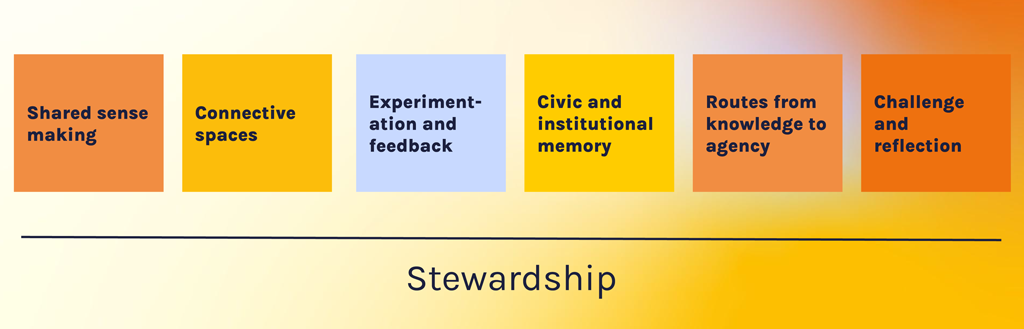
Learning infrastructure for place.
This learning infrastructure for place operates through six interconnected mechanisms.
Shared sense-making brings different forms of evidence and experience into conversation, allowing people to develop an understanding that no single perspective could provide. Such exchanges depend on connective spaces, whether libraries, community venues, professional partnerships or digital forums, where people and knowledge can encounter one another. The test isn’t simply whether people come together, but whether they produce understanding or possibilities that would not otherwise emerge.
Experimentation and feedback enable places to test ideas, assess their effects and learn from the results. Action itself becomes a way of generating intelligence. For that learning to endure, civic and institutional memory preserves what has been discovered, including the reasoning behind decisions and insights gleaned, so that valuable knowledge is not lost when projects end or people move on.
Learning also needs to influence what happens next. Routes from knowledge to agency connect understanding with the authority, resources and opportunities required to make change, while challenge and reflection create space to question assumptions, consider competing interpretations and recognise when an approach has not worked. Challenge, friction and failure can all reveal things that the prevailing view cannot see for itself.
These mechanisms are not new, nor do they serve the same purpose. Their significance lies in how they work together: connecting knowledge and perspectives, testing understanding through action, preserving what is learned, translating insight into influence and keeping established thinking open to challenge. Within EPI, they provide the practical foundations through which the seven capabilities can develop – turning intelligence distributed across a place into a collective capacity to understand, act, learn and adapt.
Building learning infrastructure does not necessarily mean starting from scratch. Much of it may already exist in the knowledge held by communities, the experience of local organisations, the records and documentation of past decisions, the heritage of a place and the spaces where people meet and exchange ideas. The opportunity lies in recognising these often overlooked assets, understanding how they contribute to collective intelligence and connecting what is currently fragmented. By strengthening the relationships between them, places can build on what they already know, preserve what they have learned and develop a greater capacity to shape what happens next.
From knowing more to changing what happens next
The intelligence needed to shape better places is rarely absent. Much of it already exists, held across communities, organisations, institutions and the accumulated experience of a place. The challenge is to connect that intelligence, give it influence and ensure that what is learned changes what happens next.
Expanded Place Intelligence offers a practical framework for doing so. Its seven capabilities and six mechanisms of learning infrastructure help place leaders recognise existing strengths, uncover gaps and build the collective capacity to respond to change.
The ambition is not simply to make places smarter. It is to make them better at shaping their own futures.
Put Expanded Place Intelligence to work
Place leaders are expected to deliver more with less, tackle complex challenges and create lasting benefits for their communities. Calvium helps you make better use of the knowledge, people and resources already within your place to make progress where it matters.
Contact Calvium to discover how EPI can help you break through barriers, bring people together and turn your ambitions into action.
- Email: hello@calvium.com
- Call: +44 (0) 117 226 2000
- Find out more about our consultancy services.
FAQs: EPI, smart cities, digital technology and AI
1. How does Expanded Place Intelligence differ from the smart city approach?
Traditional smart-city approaches mostly focus on using technology to collect data, monitor urban systems and improve efficiency. Expanded Place Intelligence (EPI) takes a broader view, recognising that a place’s intelligence also resides in its communities, institutions, relationships and accumulated experience. Rather than asking only how technology can make urban systems smarter, EPI considers how places can become better at understanding themselves, making collective decisions and learning from experience.
2. What role does digital technology play in Expanded Place Intelligence?
Digital technology can help places discover, connect and share knowledge that might otherwise remain fragmented. Sensors, mapping tools, digital platforms and data systems can reveal patterns, support collaboration and make information more accessible. However, their value within EPI depends on what happens beyond the technology itself: whether the insights reach the right people, influence decisions and contribute to lasting improvements in how a place operates.
3. How can artificial intelligence support places that learn?
AI can help analyse complex information, identify patterns, explore possible futures and make existing knowledge easier to access. For example, it could help a local authority examine environmental data alongside community feedback to develop a richer understanding of a neighbourhood. But AI systems learning from data is not the same as a place learning from experience. For EPI, the important question is whether AI helps people and institutions develop shared understanding, make informed decisions and adapt their approach over time.
4. How can place leaders decide whether an AI or digital technology investment will genuinely benefit their place?
EPI encourages place leaders to begin with the capabilities they want to strengthen, rather than the technology they want to introduce. What does the place need to understand better? Whose knowledge is missing? What prevents useful insights from becoming action? These questions help reveal where digital technology could make a meaningful contribution, what human and organisational support it will require, and whether the benefits can endure beyond an individual project. The aim is to invest in technology that strengthens a place’s collective capacity, not simply adds another digital system.