
In today’s fast-moving world, needs and priorities are ever-changing. While technology is driving rapid innovation, it is simultaneously creating more uncertainty, which makes mid-long-term transformation roadmaps harder to specify or rely on.
Organisations increasingly need solutions that can address immediate problems, but also adapt as circumstances change.
We’ve long experience at Calvium of developing bespoke digital products, which are valuable for creating distinctive work and operating at new technology frontiers. They demand consultative expertise alongside technical delivery. But as clients adapt to more agile business approaches, they now require our varied expertise in a different way – a model which delivers the speed, flexibility and impact necessary for modern business.
This blog will share how we have been developing our Product + Consultancy model, what it looks like in practice and how it delivers client-specific solutions.
Bespoke or Product + Consultancy
Firstly, it is important to point out that this is not a battle between the two; both have their benefits, depending on the end goal.
Bespoke simply means creating a specific solution for a client. Typically, it takes more time because much of the work is done from scratch and involves several disciplines – for example, researchers, designers and developers will all shape and refine the solution. Once complete, that solution is delivered and belongs to the client.
Our new Product + Consultancy (P+C) model is a faster way to create a solution that meets a client’s immediate needs, and has designed-in flexibility for further customisation in the short-term.

Photo: Eehjay Creatives
This has stemmed from work with several clients, where there were clear common needs that were satisfied by digital ‘modules’ that could be tailored and deployed into established enterprise systems.
This approach can be thought of a bit like a starter pack, which proves the concept before being built into the enterprise. So the parts have already been built and tested, and can then be adapted for each client accordingly.
It may be a particularly suitable approach when there are many parts of an operation that need to be optimised. Rather than being a bespoke offering, the nature of P&C means the ‘modules’ can be moved around when needed.
To ensure the ‘module’ products are optimised for individual contexts and maximum value, expert consultancy supports clients to identify how to tailor the adapted products and best deploy them within the business. This element of the P+C model ensures businesses are using products and services to their full potential, enabling continuous improvement and innovation.
P+C in practice
We currently have three offerings as part of our P+C suite of services, which shall be debuting at the Blue Earth Summit 2026 in October. The first is our Climate Impact Report. Using AI, these reports provide organisations with information about how their physical assets will perform over time in a range of climate scenarios, such as heat risk, rainfall and wind exposure. For example, logistics companies may want to ask how will tyres perform in extreme heat in 10 years’ time? For energy suppliers, how will rainfall impact the siting of infrastructure 40 years from now? Will a multinational enterprise’s officeblocks be liable to flooding in five years?
This kind of data is available but it is often difficult to aggregate and make sense of. Using our in-house technology, our consultants are able to bring all of that together in one easy-to-understand report, including all the relevant datasets for each individual business. These insights can then be used to help make important organisational decisions and changes – in this case, around environmental and operational sustainability.
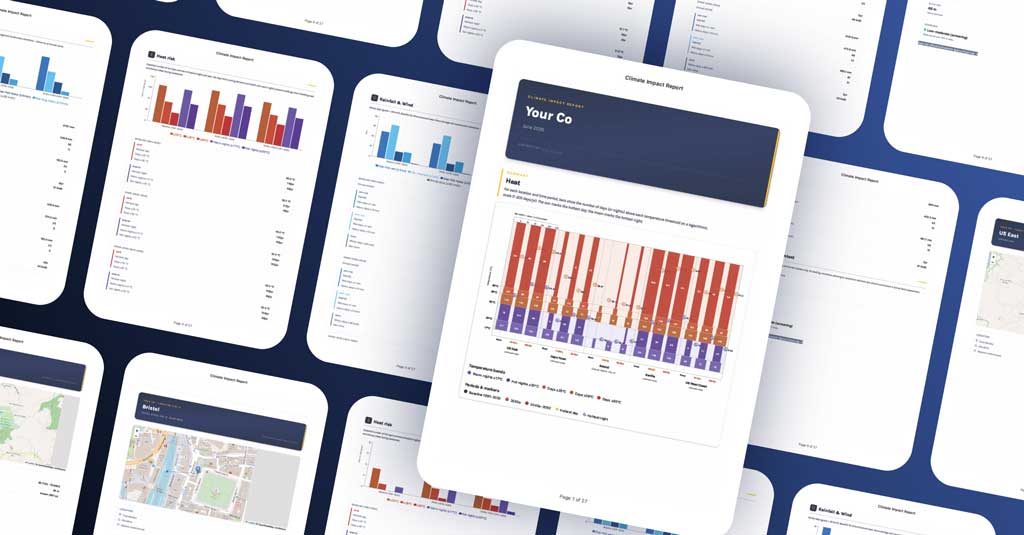
Climate Impact Reports turn complex datasets into straightforward, decision-useful metrics. Share with your C-Suite to inform adaptation options, maintenance planning, leasing decisions, capex prioritisation, or when to commission deeper engineering studies.
The second, CurLinks, is a platform that makes it easy to locate and curate links to organisational assets and knowledge sources. For example, in larger organisations or consortia projects, knowledge is distributed across many different systems and drives, like SharePoint and Google, so it can be difficult to know where things are located. CurLinks allows those documents and assets to be aggregated and managed in a central system, making it easy to curate relevant information for whatever is needed – be it a new employee or someone joining a project. It also attributes link owners, so there is clear responsibility for broken or outdated links.
The third is an AI-powered platform we have called Canyon, which has been designed to help organisations pair their practice, documentation and processes to policy, regulation and compliance certification criteria. When existing policies are uploaded, Canyon analyses an organisation’s evidence against target standards, mapping the citations. It then highlights what is missing and what needs updating to progress to certification, helping to save both research and audit preparation time.

Photo: Christian Brok
Optimised integration
One of the problems we often see is businesses trying to jump too quickly to the finished solution. There can be pressure to adopt a new technology, launch a new product or transform a service before the groundwork has been done.
In reality, digital transformation is rarely a single project. It can take years, and much of the important work happens before the more visible results appear. Organisations first need to understand what they have, what is possible and what needs to change.
Calvium’s role is to guide clients through that process – not with a fixed consultancy offer, but by bringing the right strategic and operational expertise to each challenge they are facing. In P+C, that means looking at the business holistically: understanding organisational risk, the economic environment, business priorities and competition, alongside practical considerations such as legacy integration, cybersecurity and accessibility.
Sometimes the first challenge is simply understanding and making better use of what an organisation already owns. Sometimes the opportunity lies in connecting information that has previously been separate. With Climate Impact Reports, for example, that means integrating a client’s own data with external data to create new possibilities for exploration and discovery. In other cases, the challenge comes from changes outside the organisation, such as updated regulation and legal requirements.
These are very different problems, but they point to the same need: organisations require partners who can understand the wider context, identify what needs to happen next and provide the specialist expertise to make it possible. We usually work alongside clients’ existing IT and digital teams, adding capacity and expertise rather than duplicating what is already there. As technology, security requirements and regulation continue to change, that kind of ongoing relationship is becoming increasingly valuable.
 In summary
Once again, it is important to reiterate that it is not a one-size-fits-all approach. The right strategy and way forward depends on the problem and where the business is at that point in time.
Bespoke makes sense when there’s a genuinely unique challenge that requires something new and specialised. Our new P+C offer gives clients a proven starting point that can still be adapted around their specific needs as they go. This level of agility and flexibility is becoming increasingly attractive and advantageous given the current pace of change. Couple this with the additional skills and knowledge of our team, who have been carrying out high-quality, secure software development for years, and the results will bloom.
Whatever the choice, it is human expertise that brings those organisational goals to life, which relies on trust, collaboration and understanding the holistic context.
Ready to transform the digital systems driving your business? Book a strategic conversation with our CEO, Jo Reid, to map out your vision and see how Calvium can bring it to life:
Calvium is a UK digital consultancy and product partner specialising in responsible digital innovation, helping enterprises modernise complex systems and build secure, accessible digital products, with expertise across responsible AI, software engineering, research, design, accessibility and digital placemaking.