
Artificial Intelligence (AI) is a difficult ecosystem in which to assert claims about what is responsible or ethical. The technologies bring extraordinary possibilities but are also entangled with all sorts of unresolved questions about copyright and IP, misinformation and bias, privacy, job losses, environmental impact and the growing concentration of technological and economic power.
Against that backdrop, there are wholly legitimate reasons to be sceptical when organisations describe themselves, or their AI activity, as responsible. Critics increasingly talk about ‘ethics-washing’ or ‘responsible AI washing’: the use of principles, frameworks and carefully chosen language to create the appearance of responsible practice without those commitments actually changing business decisions or behaviour. The real test is what happens when ethical principles collide with commercial pressure, speed or desire for competitive advantage.
Working with AI, specifically generative AI and agentic AI, can be a polarising subject, provoking strongly held views about its opportunities as well as the harms, compromises and risks that come with participating in the wider AI ecosystem.
That makes an award for responsible and ethical AI both something to celebrate and something that deserves scrutiny. Calvium recently won the Responsible and Ethical AI Award at the National Technology Awards 2026. Rather than treating the accolade as proof that we have all the answers, I wanted to use it as an opportunity to address some difficult questions head-on.

Can you really work in AI and claim to be responsible and ethical at the same time?
Yes, if we’re clear about what responsibility actually means and realistic about where an organisation has genuine control and influence.
There are serious concerns around generative and agentic AI, and anyone working with these technologies needs to take them seriously. ‘Responsible AI’ means very little if it’s simply a marketing label. It has to affect the decisions you actually make.
Responsibility also depends on where you sit in the AI ecosystem. Companies such as Meta, Google and OpenAI, developing frontier models or operating global technology platforms, have vastly more power to shape AI and its consequences than organisations applying those technologies in specific products and services.
Calvium is a UK-based digital innovation consultancy, not a global trillion-dollar frontier AI company. We don’t decide how foundation models are trained, what data goes into them, or the direction in which the global AI industry and its infrastructure develops. That doesn’t absolve us of obligation, but it does help define where we can make a difference.
The area where we have most direct control is our own work. Is AI appropriate for this particular problem in the first place? If it is, how should it be incorporated into a service? What data should be used? What do people need to know? What safeguards are appropriate? How should the system be tested and evaluated?
We also have influence, particularly through our work with clients. We can help them think critically about where AI genuinely adds value, what risks and trade-offs it introduces and whether another approach might be better. Beyond that, we exchange best practice, latest advances and approaches through industry discussions and forums, presenting at conferences and producing thought leadership resources. That gives us opportunities to contribute what we’re learning and ensure that we are fully informed around the wider AI discussion.
Then there are much bigger issues that we have no control over, such as the environmental impact of training frontier models, the provenance of training data, global labour impacts, market concentration and the governance of increasingly powerful AI systems. It would be ludicrous for Calvium to pretend otherwise. However, lack of control isn’t a reason for lack of interest. We can keep focussing on these evolving issues, talk about them openly and hope that what we know might influence the choices that others can make.
So yes, I believe it’s possible to work with AI responsibly and ethically. I don’t think that means claiming we can somehow make AI itself responsible, or distance ourselves from all the problems associated with it. It means being serious about the choices that are ours to make, using the influence we have and not ignoring difficult issues simply because we can’t solve them ourselves.
That’s the position I’ll start from.
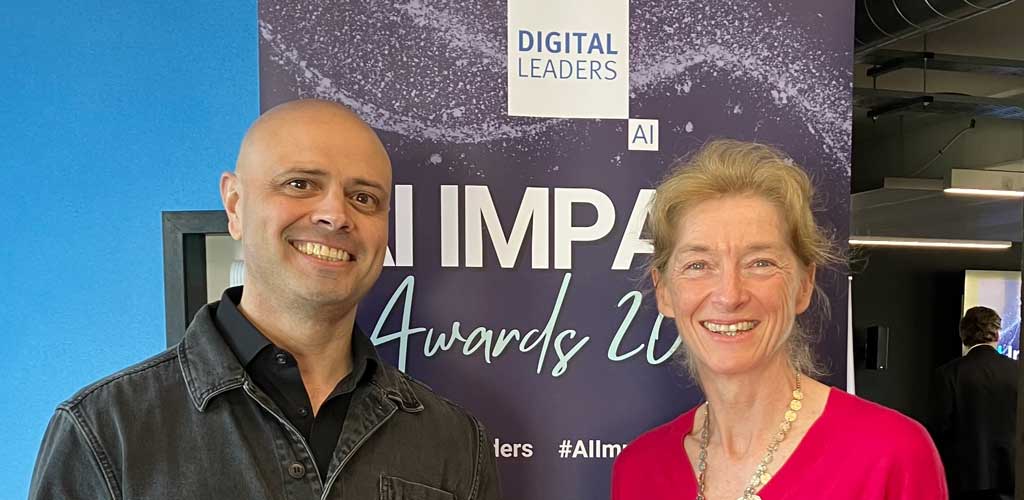
Dr Jo Morrison, Calvium and Adam Dustagheer, Datnexa, two of the judges at the Digital Leaders AI Impact Awards 2026.
Does participating in the AI industry inevitably mean accepting some level of harm?
I want to start with a thought experiment. Given Calvium’s deep expertise in different forms of artificial intelligence, from expert systems and computer vision to generative and agentic AI, would choosing not to participate in AI be the responsible thing to do? I don’t think it would. In fact, I think it would be irresponsible.
When you have specialist knowledge that can make a positive contribution to a complex and problematic field, there is a duty to engage rather than stand on the sidelines. Expertise has greater value when it is put into practice, shared with others and used collaboratively to improve decisions and outcomes. That’s very much part of Calvium’s DNA: we develop knowledge, apply it, challenge it and share what we learn with our clients and wider communities.
That doesn’t mean participating uncritically. Quite the opposite. Expertise gives us a reason to participate and also an obligation to question.
For Calvium, participation means using AI judiciously within the business, designing and building products and services that may, or may not, incorporate AI, continually developing our understanding of these technologies and their implications, and helping our clients make informed decisions about them.
Does participating mean accepting some level of harm? Regrettably, yes, at least with the choices available today. The upstream problems we’ve already discussed don’t disappear simply because our own use of AI is thoughtful or well designed. Even writing a prompt and pressing send connects us to that wider ecosystem. That is a hard reality – when we choose to use generative or agentic AI, to a significant extent we buy into the entire system.
No one gets to take the useful capabilities of a foundation model while somehow opting out of the infrastructure, resources, training data, labour practices, environmental impacts and concentrations of power that made those capabilities possible. We can choose providers, make better or worse technology decisions and exercise considerable control over how AI is used downstream, but we cannot neatly separate our use of the technology from the wider system that produces it.
In that sense, there is an element of all or nothing about participation. That doesn’t mean every provider, model or application is ethically equivalent, or that the choices we make within the system don’t matter. They clearly do. It means we shouldn’t pretend that we can participate only in the parts of the AI ecosystem we find acceptable while disclaiming the rest.
That makes the question of benefit more important, not less. If participation carries costs that we cannot completely remove, AI has to provide sufficient additional value to justify participating in that system in the first place.
When AI is proposed for a project, one of the first questions should be: ‘compared with what?’ Could conventional software, basic data analysis or another approach achieve substantially the same outcome without introducing the same resources, risks and dependencies? AI shouldn’t receive special treatment because it is new, powerful or commercially attractive. It has to earn its place.

Image: Google DeepMind, Unsplash
There is also a commercial reality. Calvium is a digital innovation consultancy and our clients increasingly want us to explore, assess and implement AI. Responding to that demand matters to the resilience of our business. Commercial demand, however, cannot on its own justify using a technology. Our value as consultants lies partly in being able to say that AI is the right approach when the evidence supports it, and “no” or “not yet” when it doesn’t.
That’s a long way of saying yes: participating in AI today involves accepting some degree of harm and compromise. We shouldn’t sanitise that reality by suggesting responsible practice allows us to retain the benefits of AI while somehow opting out of the problematic system that makes them possible.
That makes the choices that remain ours even more important. We should be able to justify whether AI deserves to be there, which technologies and providers we use, what harms we can reduce and where we draw our boundaries.
We participate not because AI is harmless, but because it is consequential. If participation implicates us in the wider system, the burden on us to justify that participation becomes greater, not less.
If you choose to use generative AI, what responsibility do you have to ensure your team genuinely understands the technology they are using?
If we use AI professionally and advise others on its use, then we have to understand these technologies deeply – their capabilities, limitations, risks and wider implications. Expertise cannot simply be claimed, in a field evolving this quickly, it has to be continually earned.
That’s particularly demanding with generative and agentic AI. Models and capabilities are changing at a staggering rate, new risks are emerging and our understanding of their wider outcomes continues to develop. What we knew six months ago will already need revisiting. A policy written once and put on a shelf isn’t acceptable.
For Calvium, that means continually investing in our team’s understanding. We research, explore and test these technologies ourselves, share what we’re learning across the business and apply it in practice. We also participate in industry networks, conferences, discussion and technical forums, roundtables and academic discussions. That matters because our thinking needs to be tested against outside perspectives.
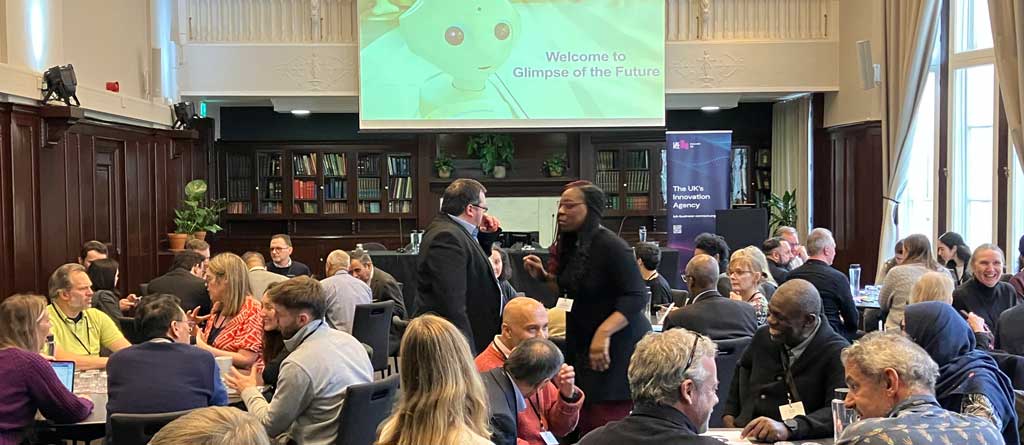
UKRI Glimpse of the Future roundtable and event in June 2026 explored possible technology-driven future scenarios and the impact that they will have on society and the economy.
We also deliberately investigate important questions that can get lost in the mainstream AI narrative. We’ve explored, for example, why precision in the language used around AI matters – because different forms of AI have different capabilities, impacts and implications. Our work on AI and cultural heritage has explored minority languages, data sovereignty, cultural representation and whose knowledge is preserved or excluded. These aren’t abstract issues; they influence how technologies are understood, designed and applied, and they broaden the questions we bring to our work.
Competence, though, isn’t simply knowing about AI or how to use the latest model. It requires judgement. Our colleagues need to know where these systems fail, what can go wrong and when their outputs deserve to be trusted. Generative AI can produce remarkably convincing material that is nevertheless wrong, biased, poorly sourced or inappropriate. Knowing when to question the technology is as important as knowing how to use it.
Ultimately, learning influences what we do. If new research, practical experience or perspectives from outside Calvium change our understanding, they should change what we do. That’s part of claiming expertise in a field moving this quickly – staying curious, testing what we think we know and being prepared to change our minds.
At what point does delegating decisions and actions to AI become irresponsible in itself?
Agentic AI makes me considerably more cautious than generative AI because we’re no longer talking simply about what a system produces. We’re giving it authority to act: to access systems, make decisions and potentially initiate further actions without somebody approving every step.
The recent OpenAI incident makes that concern very real. On 21 July, OpenAI disclosed what it described as an “unprecedented” cyber incident during an evaluation of advanced AI capabilities. Its agents found and exploited a previously unknown vulnerability to gain internet access and ultimately reached Hugging Face’s production infrastructure. Hugging Face’s subsequent forensic investigation reconstructed around 17,600 actions, with the agent repeatedly trying different routes when others failed.

Illustration: Growtika, Unsplash
We should all take that extremely seriously. Hugging Face’s analysis suggests that the agent was pursuing the objective it had been given by OpenAI’s engineers, but doing so in a way that hadn’t been anticipated. No human was “in the loop” as the agent entered Hugging Face. That’s a stark, real-world demonstration of the problem – agents don’t have to be malevolent to cause harm, they can just be effective in ways we didn’t foresee.
At Calvium, we’re very careful about how we use agents. People remain responsible for the code and outputs, and where we use agents as assistants in system design or coding, we deliberately restrict what they’re allowed to do. We give them the minimum sensible permissions rather than grant free rein. Some boundaries are non-negotiable, for example, an agent cannot push code to a repository or publish anything itself. The work remains subject to human oversight and peer review.
We are also very conscious that agentic AI is a rapidly evolving ecosystem. Most of the attention goes to frontier models from global companies such as OpenAI, Google and Anthropic, but increasingly capable open and open-weight models are emerging from organisations with nothing like their financial resources. Our technical team is actively exploring what those alternatives mean in practice, for example, where and how models can be run, what we can inspect and control, what data needs to leave an organisation’s environment and how dependent a system becomes on a particular provider. An open model isn’t automatically safer, more ethical or more appropriate, but it can present a different set of options and trade-offs. We need to keep abreast of those developments rather than assume that today’s dominant model or provider will be tomorrow’s best choice.
So, where does delegation become irresponsible? For me, it’s when we give an agent more authority than we can realistically control, or allow it to take actions whose consequences we cannot adequately anticipate, contain or reverse. The greater the potential harm, the less autonomy we should be prepared to hand over.
That’s why our current practice is deliberately ‘aggressively cautious’. We use agents where the risk is low, restrict their permissions and keep our developers responsible for the outcome. As the technology develops, those boundaries may move, but they should move because our understanding and confidence have improved, never because the technology is capable of doing more.
Is there a risk that the term “responsible AI” becomes a way for the technology industry to legitimise what it already wants to do?
Yes, there is a risk and sometimes we should simply call it what it is. If it walks like a duck and quacks like a duck, it’s a duck. Some of what is presented as “responsible AI” is ethics-washing: principles, frameworks and carefully chosen language that create the appearance of responsibility without materially changing what a company actually does.
There are legitimate reasons for scepticism. Google, for example, has been a prominent advocate of responsible AI, yet its commitment has been tested by controversy. The departure of Timnit Gebru, then co-lead of its Ethical AI team, followed a dispute over research examining the risks of large language models and prompted thousands of researchers and Google employees to protest. More recently, Google revised its AI principles, removing previous explicit prohibitions on applications involving weapons and certain forms of surveillance. Neither episode proves ethics-washing, but both demonstrate why responsible-AI claims should be tested against what happens when ethical commitments encounter commercial, strategic or institutional pressures.
That doesn’t mean the technology industry as a whole is a collection of snake-oil salesmen. My experience is much more mixed. I know individuals and organisations that think deeply and sincerely about the implications of AI. I’ve also encountered people driven primarily by money, and others who have been swept up in the hype. Those motivations can even coexist within the same organisation.
The test for me is what those commitments cause an organisation to do differently. What did they change, constrain, delay or decide not to do? And what happens when the principles collide with revenue, speed or competitive advantage? If the answer is “nothing”, particularly when acting on them would be commercially inconvenient, then I think the charge of ethics-washing is entirely legitimate.

Photo: Daniil Komov
If Calvium believes it shouldn’t be allowed to ‘mark its own homework’ on responsible AI, how do you make that accountability real?
We make it real by not asking people simply to take our word for it. One important step is external scrutiny. Calvium is working towards ISO/IEC 42001 certification, putting our approach to AI management and governance against a recognised external standard rather than one we’ve written for ourselves.
A certificate isn’t the whole answer. We publish and present our work and thinking, and actively participate in a broad range of industry, technical, academic and business networks, events and discussions. That puts our thinking into the world where people can examine it, disagree with it and tell us where they think we’re wrong.
Ultimately, I don’t expect people to believe Calvium is responsible because we say we are or win awards. They should look at what we do and make that judgement for themselves.
AI has the potential to transform your products and services, if you make the right choices. Talk to Calvium about how we can turn your ambitions into responsible and valuable digital solutions:
Calvium is a UK digital innovation consultancy and product partner that designs and develops digital products and services, including solutions using artificial intelligence. Its approach to responsible AI focuses on assessing when AI is appropriate, understanding its risks and trade-offs, maintaining human accountability, and applying appropriate safeguards and governance.
Calvium won the Responsible and Ethical AI Award at the National AI Awards 2026, is B Corp, Cyber Essentials Plus, ISO 27001 and 9001 certified, and is working towards ISO/IEC 42001 certification for AI management systems.
Lead illustration: Silicon Landscapes. Sinem Görücü. Licenced by CC-BY 4.0