Empowering people to strengthen their bones by integrating science-informed, bone-specific movement into daily life

Introduction
The Bone Booster app aims to revolutionise bone strength by empowering people – particularly women at higher risk of osteoporosis due to menopause – to strengthen their bones through a science-informed approach to integrating bone-specific movement into daily life. Designed to tackle a critical health challenge, The Bone Booster app offers a game-changing solution for improving lifelong wellbeing and vitality.
Calvium has been working with Vicky Stiles, a senior lecturer at the University of Exeter, to improve the design and usability of the existing app so it is in shape to be used in a real world setting.
This app is our latest collaboration with the University of Exeter. Taking a data-driven, user-centric approach to innovation has been key to the current project’s success so far, which is quickly transitioning from prototype to product.
Context
With a background in biomechanics, Vicky Stiles has dedicated her academic career to research, education and innovation around helping women to improve their bone health. A core part of her expertise is in collecting and analysing lab-based biomechanical data to identify activities that promote healthy bones.
Her research has found that accumulating a relatively small amount of targeted impact activity is associated with stronger bones in both young and mature women.
Keen to find ways to use technology and insights to encourage engagement with accessible bone-specific exercises, Vicky and her team are developing a prototype app to help empower both men and women with taking control of their bone health.
Challenge
One of the primary challenges of a research project like this is getting enough data to verify the effectiveness of objectives, and then being able to tell if the data is accurate.
The second challenge was designing and developing something that would actually encourage behaviour change; in this case, getting people to do specific, likely unfamiliar, bone-specific exercises rather than just general exercise.
While the initial app that had been developed was sufficient in getting some data for people, it needed a lot of changes to the design and usability. Which is when Calvium came on board.
Calvium’s contribution
We were recommended to Vicky when she began looking for a company with experience of developing apps from prototype to product. Calvium loves working with researchers, particularly in a university context, so we jumped at the chance to be a part of the project.
Given the success of The Bone Booster app depends on its ability to validate exercise efforts on bone health, we were asked to make recommendations for interpreting the data so it’s more personalised and accessible. To make it easier for app users to understand the outcomes of their efforts, we are translating data into graphs and graphics so they can make sense of their bone-specific movement patterns.
The research data gathered will also be a vital step in researchers being able to pinpoint the most important findings and make more informed decisions.
A key part of our work focuses on streamlining the user experience of the app and coming up with different designs that encourage people to keep using it and support long-term behaviour change. This is something we were tasked with doing for Open Bionics’ Hero Arm app, which was designed with the aim of helping users to get the most benefit from their prosthetic arm.
We are also styling and branding The Bone Booster app to make sure it appeals to their target audiences. By supporting long-term behaviour change, the app has the potential to both reduce health issues later in life and reduce healthcare costs.
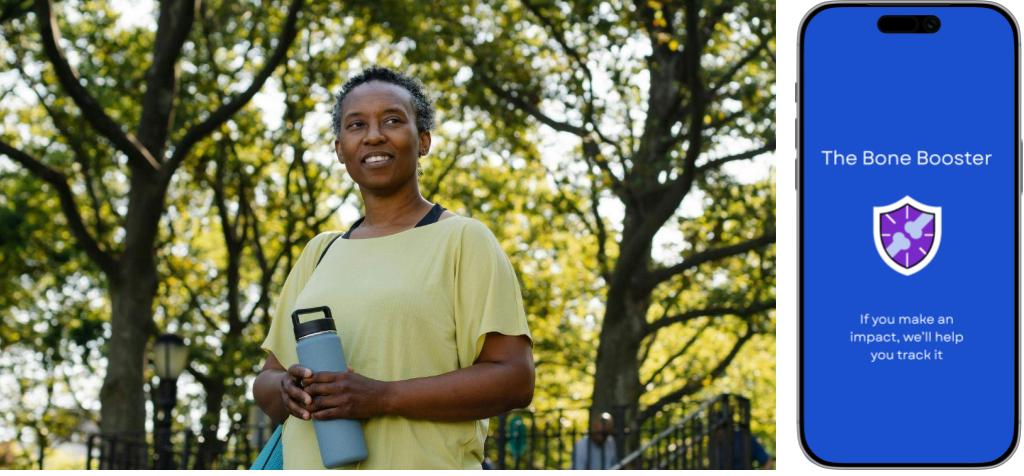
Photo: Liliana Drew
Next steps
We know from experience that research and development projects often change direction as they go and you can’t ever know the answers for certain. Agility and flexibility are key; with this in mind, we will work with Vicky to help her make the best choices about product testing and development based on market feedback at that stage.
We will be considering all the different potential paths of taking the product to market and what a whole system approach might look like. One example could be educational games for wider awareness, which is something we did for Envirocrops, which helped to make a relatively niche and complex subject more accessible for all ages and abilities.
Really importantly, research and innovation requires funding, and so the long-term ambition of this project is to secure further funding and turn this into a full-scale marketable product that has a real-world positive impact on health.