

The digital age has transformed the experience economy. Digital technologies are now integral to major events and their host cities, augmenting locations and experiences into dynamic hybrid spaces where people gather, interact, record and share memorable experiences.
Few city events are larger than the London Marathon, which attracts more than 50,000 participants each year, alongside thousands of spectators who flock to the UK’s capital. As one of the world’s most prestigious races, it brings together local, national and international participants, all with different access needs and expectations. In 2025, more than 1,500 disabled people registered to take part, including eight Paralympic athletes from multiple sports.
As highlighted in Calvium’s ‘Experience Economy in the Digital Age‘ report, digital technologies now play an essential role throughout a traveller’s journey, from research and planning to the stay itself and even the post-visit experience. If destination events, such as the London marathon, fail to integrate these location-focused technologies into how they design and present experiences, they risk falling short of the services people increasingly value and expect.
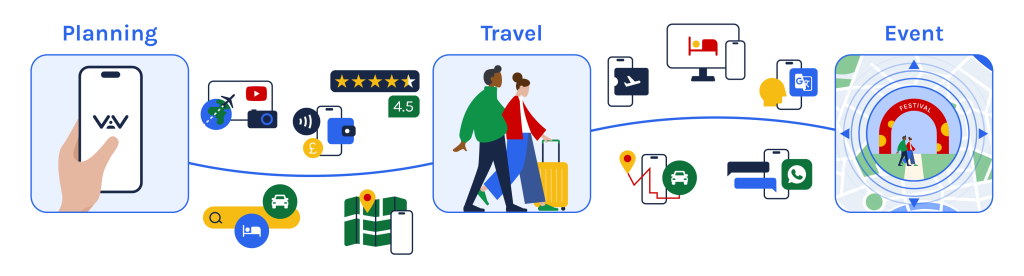
From planning to attending large events, digital technologies are intrinsic to the process, e.g. research, reviews, booking travel, navigation, peer advice, ticketing, translation and communication apps. For a more detailed mapping of the landscape, download our report ‘Experience economy in the digital age.‘
Digital placemaking – the use of technology to strengthen the connection between people and physical spaces – already supports many aspects of event attendance, but the potential for digital innovation extends much further.
As the digital experience economy continues to grow, digital products and services are becoming an essential part of participation. In this article, we explore some of the ways that technologies are embedded within city events, with the London Marathon as a prime example, and how they support the experiences of those attending.
Wayfinding and mobility
Getting to and from large-scale events can be a challenge in itself, especially if someone is coming from afar or with specific access needs. Whatever a person’s physical ability, there will be questions around how to get there, if it will be easy to get on public transport or a shuttle bus, if there will be toilets along the way, what parking and accommodation is available and more?
For a cycling race, for example, someone may need to take a bike or handbike on public transport with limited space, or it may be physically impossible to get equipment on any transport that isn’t a car. A wheelchair user will need to know if there are ramps and accessible toilets at an arena.

Photo: Umair Dingmar
This is where route-planning apps can be particularly helpful, ensuring smooth planning and scheduling for both attendees and organisers. While apps like Citymapper provide users with up-to-date public transport options, others like Waze give real-time traffic updates, navigation and smart scheduling to help people avoid delays. Some of these apps allow event organisers to partner with them to map events, road closures and provide custom alerts for attendees, all working together to reduce pre-event anxieties.
Specialised wayfinding apps, meanwhile – such as Calvium’s NavSta and UCanGo – support people with less-visible disabilities or sight loss to navigate complex spaces confidently. Highlighting step-free routes and inclusive amenities is not only useful when on-site, but also for planning ahead of time as it helps to provide assurance.
Event-specific technologies
Mass events are often big, busy and complicated to get around. In cases like the London Marathon, it can be like navigating a pop-up city in a city.
Dedicated apps can act as a one-stop shop for attendees, integrating tickets, providing real-time information and interactive maps. If attending a festival, for instance, maps might include stages, bars, toilets and parking. If participating in or watching a sporting event, it could be the start and finish lines, meeting points, viewing areas and transport links. It also allows participants to see course layouts and track key points, so they can plan ahead of time where they might want to have a toilet break or fill up water.
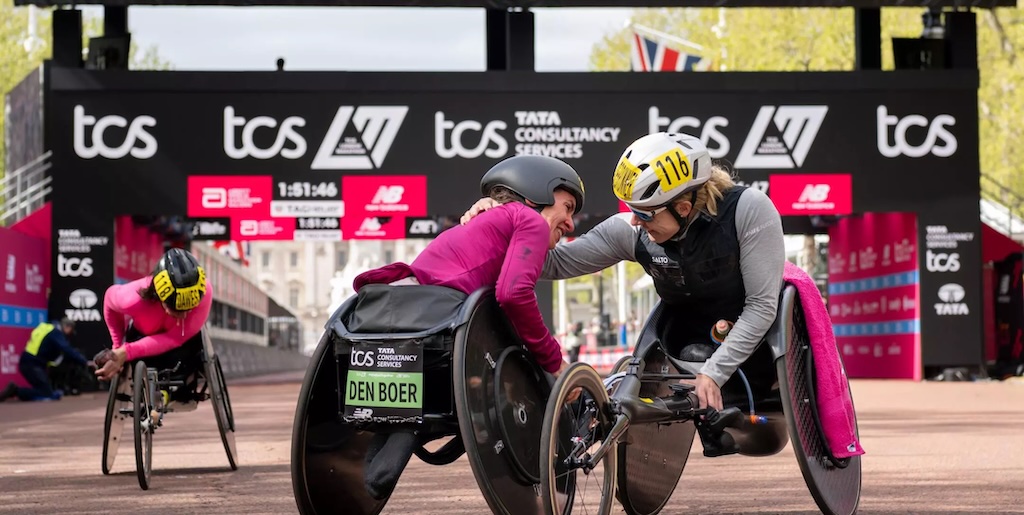
Photo: London Marathon Group
Some apps, including TCS London Marathon app, suggest accommodation, which may include transport to the start line, giving participants one less thing to worry about. The app also supports multiple languages to accommodate an international audience, positioning it further as an inclusive event.
Pre-event anxiety can be a significant barrier to attendance, whether for a race, concert or festival. Event-specific technologies can help reduce these concerns by making it easier for people to plan how they will get to, from and around the event, while also helping organisers ensure logistics run smoothly and safely on the day.
60 seconds with London Marathon runner Callum O’Driscoll
Callum O’Driscoll is a social entrepreneur in the challenge events sector, where he is currently managing director of Dream Challenges. He is also running the 2026 London Marathon for Regain, a charity which supports people with tetraplegia, and a Calvium charity partner.
Callum’s motivations for supporting Regain date back to when he was a teenager. Inspired by his Grandad, who was a competitive water skier and blind for most of his life, Callum began teaching the sport to disabled people, many of whom were tetraplegic.
“It was incredible to see the fire in people who wanted to overcome a really difficult challenge, but enjoying it at the same time,” said Callum in a recent interview with Calvium.
With the London Marathon just a few weeks away, Callum has been using digital tech to research and plan his travel options and to mitigate any navigation issues on the day.
“Everyone, no matter their physical ability, will have anxieties about taking part. Being able to orient yourself to have a clear picture of what event-day looks like is really important. It can only be done with good digital tools.”
At Dream Challenges, Callum is particularly passionate about strengthening the human connection to sporting experiences. Since 1998, the organisation has delivered more than 500 international trekking and cycling events for over 250,000 participants.
In 2026, Callum sees a clear role for AI to support participation. It is what has led him to launch Impact Tribe, an app that prioritises accessible, community-led engagement over rigorous training plans, while also providing charities with a cost-effective way to run virtual campaigns.
“AI is making it easier to understand participation – from original motivations, through barriers to showing up, training momentum, and success on the day.”
Tailoring training plans is also getting much easier, but Callum stresses the importance of making sure “human interactions remain human.” Technology can enhance, but it can’t replace.
To read more about Callum’s London Marathon fundraising journey, visit his page here.

Photo: Henry Ren
Innovation, applications and user-guided design
As Callum states, advancements in AI will only enhance digital tools that support attendance and participation. Ultimately, it will allow for more integrated solutions, more accurate tools for research and planning, and more precise real-time data and analytics that will, for example, help organisers understand crowd movement better.
There are plenty of other sectors with large events that could be using digital technologies to encourage attendance, for example in arts and culture, where Arts Council England and partners are using digital tools to make the booking process simpler for people with specific access needs. The All In digital membership system is being designed to ensure access information is communicated consistently and accurately across all participating venues, making it easier for disabled individuals to book tickets and navigate venues.
On a smaller scale, in this interview Rebecca Lockwood-Norris describes how the Place Experience Platform has been used to support places to attract and enable visitors to enjoy events, boosting footfall and the local economy. Though an events portal and advanced accessibility information, both visitors and local residents are encouraged into destinations more often and for longer. As well as economic benefits, this provision supports local health goals through increased physical activity and social interactions.
“The design of the product through the Place Experience Platform incorporates accessibility in terms of user ability and also venue accessibility, enabling all visitors and locals to have access to more information about place-based activity in the county.”
Wiltshire Council developed their digital platform for events with regular input from a broad array of stakeholders. For example, prior to the user testing they engaged carers and a disability staff network to ensure the venue accessibility tags for event listings were comprehensive and inclusive. Alongside assigning categories to events such as ‘food and drink’ or ‘arts and culture’, tags were added to clearly mark available facilities such as disabled parking, a working hearing loop or quiet space.
With the UK’s aging population, more industry innovation around travel and logistics to further improve accessibility would further increase event participation, footfall – and revenue.
Calvium’s Jo Morrison’s marathon journey for the Stroke Association
Our Director of Digital Innovation and Research, Jo Morrison, is also a keen novice runner. Jo’s running is motivated by a desire to raise awareness for the Stroke Association, a cause she has a personal connection to. So far, she has completed two marathons in support of the charity.
In April 2026, Jo is taking on an even bigger challenge by running two marathons in two weeks: the Dartmoor Marathon and the London Marathon. Through this personal challenge, she hopes once again to raise awareness of the Stroke Association and the vital support and research it provides for people affected by stroke.
Evolution of hybrid spaces and event experiences
Digital innovation for the experience economy is shifting how we navigate, participate in and value physical spaces. As seen through the lens of major events like the London Marathon, technology serves as more than a functional layer; it is a vital tool for inclusion, confidence, and community connection. By prioritising user guided design and inclusive functionality, organisations can transform complex logistics into smooth experiences that respect the diverse needs of every attendee.
The relationships between places, people and digital technologies are continually evolving, and success of places and events is increasingly dependant on this balance of sophisticated data and human centric design. Moving forward, the successful adoption of emerging technologies will rely on maintaining ethical standards and ensuring that digital enhancements always serve to expand, rather than restrict, experiences of a place.
If you are looking to enhance the accessibility, engagement, and impact of your own destination or event, we would welcome the opportunity to collaborate. As a finalist for the Responsible and Ethical AI Award at the National Technology Awards 2026, Calvium is dedicated to delivering digital innovation with purpose and care.
Would you like to discuss how digital placemaking can support your goals? Contact us and open up potential.
Subscribe to the monthly Calvium newsletter to get more insight and inspiration like this in your inbox.


