

To meet the UN’s 2030 Sustainable Development Goals, society must adopt bold new models, mindsets and ways of working that allow us to innovate at speed, responsibly.
The music business is enmeshed in creativity and tech in all aspects – from recording and touring to events and digital production – and therefore has a pivotal role to play in creating a more sustainable future. Andrew Lansley is a global sustainability and accessibility innovation specialist, who has worked across academia, culture and research for almost 30 years. Alongside his numerous professional roles, which include being a consultant for Glastonbury, Attitude is Everything and Senior Lecturer at University of Gloucester, Andrew is a professional double bassist.
In this interview, Andrew talks about what keeps him motivated, how the music business can make a positive difference and the importance of connection.
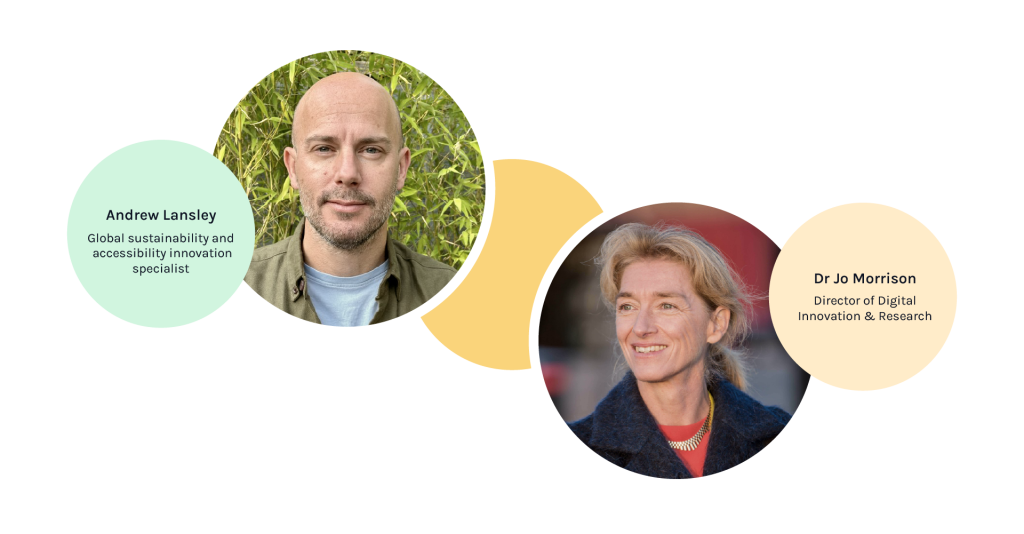
What do you do, why and what keeps you motivated?
You can broadly classify my jobs into five areas: academia, research, culture, music, and international development.
In academia I work primarily with the MusicFutures Creative Cluster at Liverpool John Moores University, and I have been a lecturer at the University of Gloucester for 20 years. I’m involved in a series of formal and informal research clusters internationally, and work with a variety of universities and public bodies around the world including the Netherlands and Canada. Alongside this, I work with a number of cross-sector, quasi-academic, quasi-government public body organisations who are trying to apply different policy solutions or practicalities to environmental and accessible events.
As a freelancer, I am innovation manager at Cheltenham Festivals, consultant for Glastonbury, and Campaigns and Consultancy lead for Attitude is Everything. I’ve also worked to build research and knowledge exchange opportunities between the UK music industry and Berklee Institute in the US. I am also a musician and have worked as a performer for almost 20 years. As part of this, I am the vice-chair of the Musicians’ Union Members Assembly, a trustee for Youth Music, and the roster coordinator and manager for UnMute – the UK’s first disabled-led and exclusive music roster.
As for why I do it, I think I’ve got a compulsion to help people. I get involved in something, get really passionate about it and generally, when work goes well it leads to more work. I don’t want to blame autism, neither do I want to credit it, but it’s like my brain is hungry and if it’s not thinking or doing it’s sad. Having so much to do keeps me happy; it’s a weird relationship that I’m learning to live with.
Touring live music is notoriously energy intensive. Looking to the future, are there local or international sustainability and/or accessibility frameworks for live events?
Any activity involving culture – moving large amounts of people, drawing large amounts of power and creating large impacts upon infrastructure and ecosystems – is going to create carbon emissions. At the moment, there is a threshold between what events, music and the live sector can address and what we need the wider economic infrastructure and mechanics to deal with. A festival can encourage all its audiences onto public transport, but unless that public transport is fuelled from the sustainable sources and created from regenerative materials, and has upstream manufacturing impacts that are managed, there’s only so much that event organisers can be responsible for.
There are frameworks developing. Some are more transient and headline-grabbing, showing where the innovative work is. Others are more prosaic processes which involve the local authority, council meetings and spreadsheets – definitely not as headline-grabbing but making a deeper route into changing things.
The biggest impacts are currently coming from groups you won’t necessarily read about. For example, LIVE Green Clauses, which is the sub-group for the LIVE Group, has a set of principles around sustainable practices that people can adhere to. Attitude Is Everything is putting together an accessible touring guide, and Music Futures is building a sustainable, inclusive R&D ecosystem for music, and the Cultural Exchange Coalition is improving international opportunities.
Domestically, there is a lot of push around voluntary certification frameworks but there is no centralised regulation. I would say the sector has gotten bored of meeting the absolute bare minimum standards and has decided to define what progress and best practice looks like.
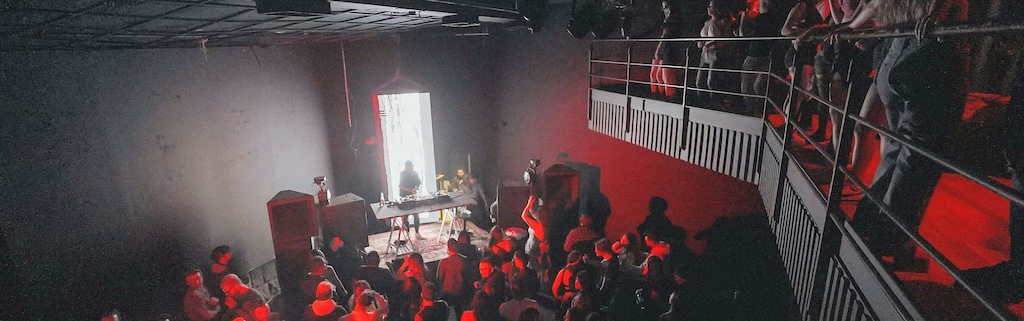
Photo: Andres Medina
What needs to happen to make even more positive change?
It’s a straightforward answer: the UK government needs to recognise and empower the events sector and local authorities at a grassroots level. All the knowledge and experience is already there, and there is a huge opportunity in February 2026 with the launch of the third Show Must Go On report. There will be a parliamentary event around that, where the sector can present their vision for a green sector transition plan to the government.
The sector has been working at a local government grassroots level for several years and we all agree on what needs to happen and why, but sometimes we still disagree on how. A maturing conversation, very much led by the LIVE Group, has meant more people within the industry have recognised that this is a community created solution. The last people to get on board is going to be the government. They need to be brave and confident that they can get progressive regulations onto their policy tracks and work with the sector and local authorities to deliver it, otherwise everyone’s going to miss another round of net zero targets.
In a recent presentation that you gave to the Disability Confident Network SW, you stated that the South West was among the most innovative and forward facing when it comes to cultural events and accessibility. Why is this? How is this being enabled? What best practice examples would you point to?
We do very well for being creative and cultural, and we have a fantastic history of being party people; the South West is the second- or third-biggest music tourism economy in the UK. In terms of innovative practice in the region, it comes up in conversation a lot with peers. Bristol has some great things going on with the Bristol Disability Equality Forum, Cheltenham’s Access To Music Conference, the programmes being run out of Gloucester by The Music Works.
Specifically in Bristol, the Beacon is one of the first major UK venues to have a public changing place, and the research and development in the region has also produced new instruments such as the MiMu gloves. I think we’re really good at being a community and there is a weighting of compassion within people working in access and events, which drive people towards being motivated in this area. That’s the foundation for why these things are so successful and progressive.
Given the climate crisis, is there anything that the music business should stop or start doing that could make a positive difference?
Like I’ve said already, the music business is doing a lot at a grassroots level. Again, everyone agrees on what we should be doing in terms of that contribution to environmental stewardship, but we need to stop disagreeing on how we approach it. Right now, you can put the same data into different emissions reporting platforms and get different results. I think there is a commercial imperative that is inhibiting progress.

Photo: AJ Dbih
One encouraging thing is that the live music sector is an ideal testing ground. If you can fix sustainability in a muddy field with 100,000 drunk people, you can fix it anywhere. Festivals allow us to build temporary infrastructure, analyse supply chains, test and develop new processes. If you do it in music then you can do it in theatres, cinemas, hospitality, and sports arenas. We need to identify where those crossovers are happening because that’s also where inefficient investment happens.
I think our industry is headed for a moment in 2026. We have a green climate transition plan, we’re able to quantify the emissions of the sector for the first time, and we’re united with the LIVE Group as to what good looks like. If the government can get on board, we’re in business.
Focusing on the urban (towns and cities): do you see live events as gathering spaces, opportunities for human connection (and consumption) in a world that is increasingly ‘personalised’?
Absolutely. We are starting to develop a mature discourse on the difference between the experience we have through the shiny black things in our pockets, and the very real and human experience we have in real life. For me, live events as gathering spaces and the opportunity for connections are more important than ever.
Culture is fascinating for two reasons. One, because it’s how humans choose to spend their time, and you learn a lot about people by what they do with their free time. But also, in a logical exposition: if you conclude the human species is successful, we automate and use technology correctly, we find balance and harmony with our planet and each other…what are we left with? We’re only left with culture and how we improve ourselves, our species, the interrelationships with each other and how we understand meaning through different perspectives.
Broadly speaking, we are seeing the death of commerce in the high street, and instead looking at these civic centres differently in terms of placemaking, culture and rebuilding community in them. That is a really exciting and creative opportunity for local authorities, event planners and supply chains to work together to make really compelling places. I believe having a communal experience is absolutely central to the human experience.
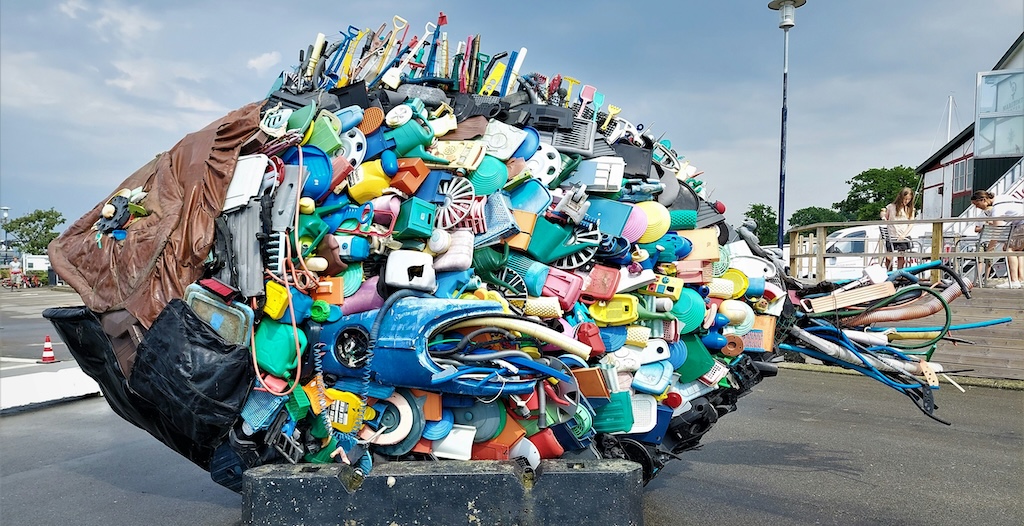
‘Garbage Fish’, by Hideaki Shibata. Photo: Pramod Kumar Sharma
Is there a role for the music industry, as a whole, to communicate any aspect of the UNs Sustainable Development Goals?
Everything I do is through the lens of the UN’s SDGs. For me, this is where the discussion gets interesting, because we talk about the music industry in an almost abstract way – an amalgamation of all these organisations and groups – but when we talk about environmental stewardship, it’s personal. We’re talking about the human. I think creative people are generally more in tune with people and the planet; all of us feel that obligation and commitment.
It’s about having a really good framework that reflects that personal ambition. We’re good at making sure we separate our food waste and recycling at home, we are good advocates and activists in a personalised space. Where our efforts aren’t met or reflected tends to be when we have to engage with wider economic principles that don’t match the same standards or expectations. So when communicating the SDGs, it can start to generate conversations around particular themes – inclusive communities, social justice, access to water – which is a useful framework for understanding the interconnected challenge we face as a species.
What’s more important is to understand what a practical application of the SDGs looks like, which involves looking at revisionist economic models such as Doughnut Economics. Whether you’re doing a gig or starting a business, it’s about making sure the social impact is such that everyone is included without crushing the environment at the same time. It puts people and planet first.
Thank you Andrew for sharing your insight, experiences and exciting collaborations that are delivering innovation and impact to audiences and the industry.
Contact us at hello@calvium.com and +44 (0) 117 226 2000 to deliver sustainable, care-filled and impacting digital innovation.
Subscribe to the monthly Calvium newsletter to get more insight and inspiration like this in your inbox.
More from our Expert Interview series
Hear from other expert practitioners, bringing their lived experience into delivering positive innovation:
- Andrew Morris, Executive Director, British Society of Soil Science
- Ben Hawes, Technology Consultant, Researcher and Associate Director, Connected Places Catapult
- Ceren Clulow, Programme Director, Connecting Cambridgeshire
- Christine Hemphill, Founder, Open Inclusion
- Daisy Narayanan MBE, Public Realm Director, The Crown Estate
- Dan Cook, Assessor, Cambridge Institute for Sustainability Leadership
- Prof Daniel Armanios, BT Professor of Major Programme Management, Saïd Business School, University of Oxford
- Joel Mills, Senior Director, Architects Foundation Communities by Design
- John Worsfold, Head of Solutions Innovation, RNIB
- Ludo Pittie, Head of Landscape, WSP
- Marc Cairns, Managing Director, New Practice
- Mark Hallett, Regeneration Associate, The Good Economy
- Paul Wilson, senior advisor and consultant on smart cities
- Prof Peter Madden, Professor of Practice in Future Cities, Cardiff University
- Steve Sayers, Chief Executive, Windmill Hill City Farm
- Warren Smith, Director of Insight, Innovation and Impact, Posterity Global
- Will Weston, Accessibility and Inclusivity Consultant, All Ways Access


